
WHAT IS CHOLESTEROL?
A fat molecule that is white, insoluble and waxy
Essential for many metabolic processes
There are different types of cholesterol
Essential for many metabolic processes
There are different types of cholesterol
- HDL is the ‘good’ cholesterol
- LDL is the ‘bad’ cholesterol
- Triglycerides, a type of fat, also form part of the lipid profile
- Eating foods rich in saturated fats will increase the amount of LDL cholesterol in the body, which is a risk factor in coronary heart disease
- High triglycerides may contribute to hardening of the arteries or thickening of the artery walls
Contents
Back to top- What is high cholesterol?
- Where does the cholesterol in our bodies come from?
- How is cholesterol transported in the body?
- What is cholesterol needed for?
- What are the risk factors for developing high cholesterol?
- What are the different ways of measuring cholesterol
- What would be considered as safe blood cholesterol levels
- Examples of saturated fatty foods to avoid
- Examples of cholesterol lowering foods
- Treatment
WHAT IS HIGH CHOLESTEROL?
Back to topHigh cholesterol, or hypercholesterolaemia, is a condition in which the amount of cholesterol in the blood exceeds normal values
This may be due to genetic or lifestyle factors. If it is genetic, it is referred to as familial hypercholesterolaemia
WHERE DOES THE CHOLESTEROL IN OUR BODIES COME FROM?
Back to top
Cholesterol comes from 2 sources:
- Animal-based foods in our diets
- Production by the liver and cells
Plant-based foods do not contain cholesterol
HOW IS CHOLESTEROL TRANSPORTED IN THE BODY?
Back to top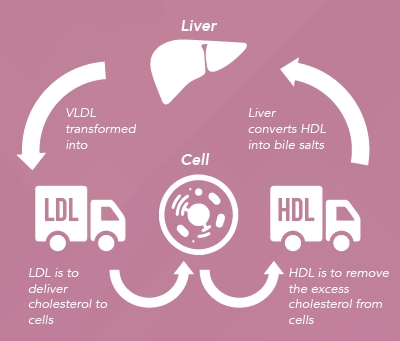
- Low-density lipoprotein (LDL) cholesterol – carries most of the cholesterol that is delivered to cells. It is called the ‘bad’ cholesterol because when its level in the bloodstream is high, it can clog up your arteries
- High-density lipoprotein (HDL) cholesterol – is called the ‘good’ cholesterol, because it helps remove excess cholesterol out of the cell
This explains why LDL is bad and HDL is good!
WHAT IS CHOLESTEROL NEEDED FOR?
Back to topWe need a small amount of cholesterol because the body uses it to:
Build the structure of cell membranes
Make hormones, like oestrogen and testosterone
Help your metabolism work efficiently
Produce vitamin D
Produce bile acids, which help the body digest fat and absorb important nutrients
Build the structure of cell membranes
Make hormones, like oestrogen and testosterone
Help your metabolism work efficiently
Produce vitamin D
Produce bile acids, which help the body digest fat and absorb important nutrients
If cholesterol has so many important functions in the body, why should I eliminate cholesterol from my diet and worry about my cholesterol levels?
You don’t need to eat foods that contain cholesterol. Your body can produce all the cholesterol it needs by itself
Excess cholesterol is harmful. Atherosclerosis is a condition in which arteries become hardened and narrowed due to the deposition of excess cholesterol (cholesterol-rich plaques) in the artery walls. This can narrow or obstruct blood vessels, leading to heart attack and stroke
Excess cholesterol is harmful. Atherosclerosis is a condition in which arteries become hardened and narrowed due to the deposition of excess cholesterol (cholesterol-rich plaques) in the artery walls. This can narrow or obstruct blood vessels, leading to heart attack and stroke
WHAT ARE THE RISK FACTORS FOR DEVELOPING HIGH CHOLESTEROL?
Back to top- Being overweight
- Incorrect diet, rich in saturated fats
- Family history of high cholesterol
- Excessive alcohol consumption
- Smoking
- Lack of exercise
- Stress
- Lack of fibre in the diet
WHAT ARE THE DIFFERENT WAYS OF MEASURING CHOLESTEROL?
Back to top- Finger prick test that will show total cholesterol for screening and follow-up purposes, ranging from total cholesterol only, to a full cholesterol lipogram profile
- Lipogram where blood is drawn and evaluated by a laboratory
- Health authorities recommend that a lipogram be done at least once a year in high risk individuals
WHAT WOULD BE CONSIDERED AS SAFE BLOOD CHOLESTEROL LEVELS?
Back to topHealth authorities recommend that cholesterol levels should be less than 5mmol per litre for total cholesterol and 3 mmol/l for LDL cholesterol if there are no other risk factors present.
WHAT ARE THE GENERAL GUIDELINES TO MANAGE HIGH CHOLESTEROL AND REDUCE THE RISK FOR CARDIOVASCULAR DISEASE?
Back to topThe South African Heart Association’s guidelines for lifestyle modifications in this regard is summarised as follows:
- Stop smoking and avoid exposure to smoke
- Increase your physical activity
- Achieve and maintain an ideal body weight
- Reduce your intake of saturated fats,
- Increase your intake of soluble fiber
- Avoid refined carbohydrates and sugars
- Consume alcohol in moderation
- Avoid adding additional salt to food
- Monitor your cholesterol levels on a regular basis
EXAMPLES OF SATURATED FATTY FOODS TO AVOID:
Back to top- Fatty or processed meats like salami and sausages
- Snack foods like chips
- Most takeaway foods, especially deep-fried foods
- Cakes, biscuits and pastries
EXAMPLES OF CHOLESTEROL LOWERING FOODS:
Back to topLDL cholesterol can be lowered by the following food types:
- Oats and legumes and chickpeas
- Garlic and onions
- Apple polyphenols found in apples
- Plant sterols (often incorporated into margarine these days)
TREATMENT
Back to topIs a healthy lifestyle on its own enough to combat high cholesterol?
For some people, diet and lifestyle changes alone are not enough, as High blood cholesterol levels often have a genetic component.
For these individuals, prescription medication such as statins may be required
Treatment of cholesterol should have a multi-approach:
(1) prevention of new formation of new cholesterol on the vessel walls
(2) removal of existing cholesterol
(3) decrease the complications that occur with the cholesterol increase
For some people, diet and lifestyle changes alone are not enough, as High blood cholesterol levels often have a genetic component.
For these individuals, prescription medication such as statins may be required
Treatment of cholesterol should have a multi-approach:
(1) prevention of new formation of new cholesterol on the vessel walls
(2) removal of existing cholesterol
(3) decrease the complications that occur with the cholesterol increase
Please Note: This is an educational information leaflet only and should not be used for diagnosis. For more information on cholesterol, consult your healthcare professional.

Cholesterol
WHAT IS CHOLESTEROL? A fat molecule that is white, insoluble and waxy Essential for many metabolic processes There are different types of cholesterol ....

Cholesterol
WHAT IS CHOLESTEROL? A fat molecule that is white, insoluble and waxy Essential for many metabolic processes There are different types of cholesterol ....

Cholesterol
WHAT IS CHOLESTEROL? A fat molecule that is white, insoluble and waxy Essential for many metabolic processes There are different types of cholesterol ....
Cholesterol
WHAT IS CHOLESTEROL? A fat molecule that is white, insoluble and waxy Essential for many metabolic processes There are different types of cholesterol ....

Cholesterol
WHAT IS CHOLESTEROL? A fat molecule that is white, insoluble and waxy Essential for many metabolic processes There are different types of cholesterol ....

Cholesterol
WHAT IS CHOLESTEROL? A fat molecule that is white, insoluble and waxy Essential for many metabolic processes There are different types of cholesterol ....