
HEALTHY SKIN MATTERS
Back to top
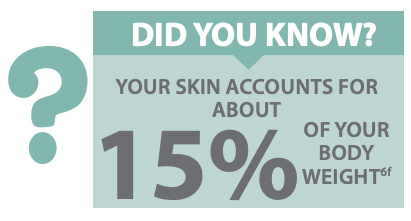
Secondly, it lets you feel things by touch.
Thirdly, it protects you.3b
WHAT IS THIS WONDROUS STUFF?
Your skin, of course!
And what does your skin ask for in return for all the wonderful things it does?
Just a little care and consideration!

Your skin constantly protects you by keeping infections out of your body and keeps you from getting sick. When you take care of your skin, you’re helping your skin do its job.
For this reason, a consistent dry skin care routine will help prevent future problems. For instance dry skin, wrinkles and even skin cancer.3a,c,d,4a

DRY SKIN
Back to top
Dry skin is a common problem that can occur at any age and for many reasons.4a
WHY IS DRY SKIN A PROBLEM?4a
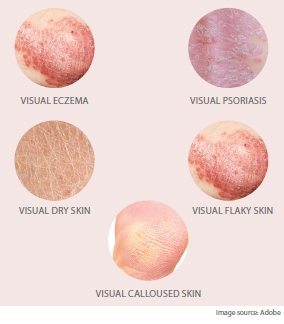
For starters, dry skin may be unsightly and itchy. What’s more, it could even cause more complex skin conditions. It is often a lifelong problem. Signs and symptoms of dry skin depend on these factors: Your age, your health, where you live, how much time you spend outdoors and the cause of the problem. Dry skin is likely to cause one or more of the following:
- A rough, dry texture which sometimes flakes and may cause itching
- Calloused skin
- Cracked and fissured skin
- Redness
- Rawness and tightness
WHY DO YOU HAVE DRY SKIN?
Back to top
TO BEGIN WITH, YOU NEED TO KNOW THE REASONS WHY YOU HAVE A DRY SKIN IN THE FIRST PLACE
CAUSES OF DRY SKIN FROM THE OUTSIDE
Back to top
- Weather. Skin tends to be driest in winter when temperatures and humidity levels plummet.
- Heat. Central heating, wood-burning stoves, space heaters and fireplaces reduce humidity and dry your skin.
- Hot baths and showers. Taking long, hot showers or baths can dry your skin. So can frequent swimming, particularly if you chlorinate your pool heavily.
- Harsh soaps and detergents. Many popular soaps, detergents and shampoos strip moisture from your skin as manufacturers formulate them to remove oil.
- Some skin conditions, such as eczema or psoriasis, can also cause dry skin.
CAUSES OF DRY SKIN FROM THE INSIDE
Back to top
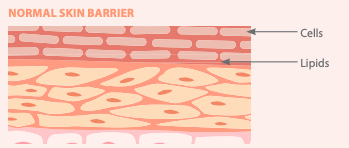
- A decrease in the production of natural oils in the body can also cause dry skin conditions as this compromises the skin barrier.6b
- In healthy skin, specialised glands release an oily substance called sebum which keeps the skin moist, supple and waterproof. As we get older, our bodies don’t produce these natural oils so effectively.7a-c
- Our skin also loses its ability to maintain water as we get older and therefore becomes drier.7d
- Babies and young children are also often susceptible to dry skin because their oil-producing glands haven’t developed properly.8a
- A person with a dry skin condition (e.g. atopic dermatitis) has a higher skin pH (less acidic); this may delay the repair of the skin barrier function.9a
- While restoring the pH to the normal skin acidity (pH 4.5-5) the body will produce the lipids needed for normal barrier function.9a
- The acidity of the skin also helps the body against attack by foreign bodies.9a
SO, WHAT PROTECTS YOUR SKIN FROM BECOMING DRY?
THE IMPORTANCE OF YOUR SKIN’S NATURAL BARRIER
Back to top
This barrier helps to keep water within the body and prevent the entrance of other potential irritants.
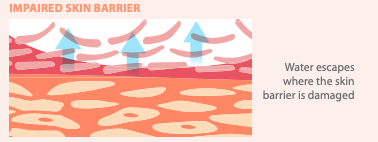
Though dry skin complications may not be life-threatening, they can have tremendous consequences for a person’s physical and mental well-being.13a
KEEPING YOUR SKIN HYDRATED AND HEALTHY
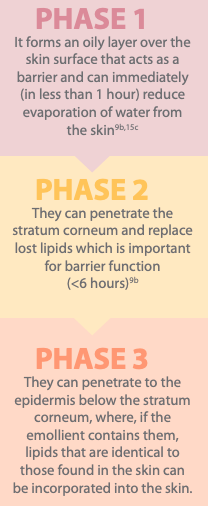
Some other emollients can prevent phase 3, thus reducing their overall effectiveness.9b
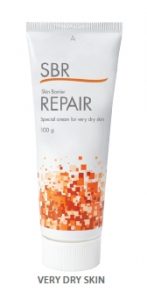
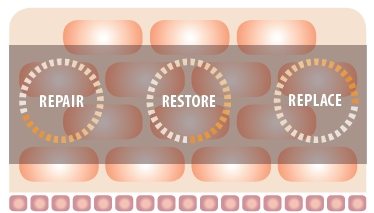
The special formulation of SBR® Repair cream is involved in all three phases to repair the skin barrier; in phase 3, it helps to heal the skin barrier faster.6a,d
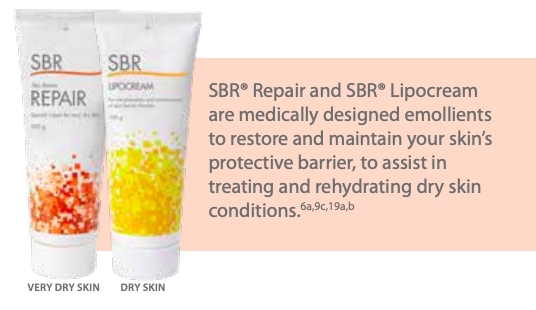
EMOLLIENTS LIKE SBR® REAPIR CREAM AND SBR® LIPOCREAM REPAIR AND PROTECT YOUR SKIN
Back to top
- Use of emollients can help repair the damage by replacing lost lipids.6a
- Studies have shown that emollients may reduce the need for topical steroids and enhance their therapeutic response.11c
- Emollients also prevent allergens, irritants and bacteria from penetrating the skin and thereby reduce the development of dry skin conditions (e.g. eczema) or infection.15c
- An effective dry skin care routine using emollients can soothe, moisturise and protect the skin, helping to reduce the dry skin conditions, e.g. eczema flares.15a
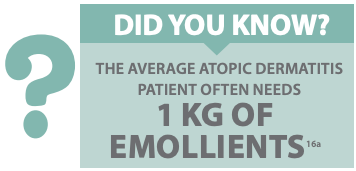
EMOLLIENTS SHOULD BE USED EVERY DAY
- Emollients make the skin feel more comfortable and less itchy.15f
- They keep the skin moist and flexible, helping to prevent cracks.15f
- You should use an emollient daily to protect and repair your skin’s barrier.15a,c,f
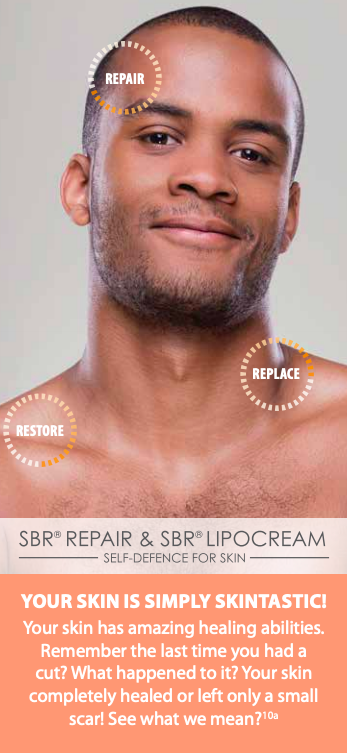
The skin has excellent healing abilities. Remember the last time you had a cut? What happened to it? Your skin completely healed or left only a small scar! See what we mean?10
TOP TIPS ON YOUR EMOLLIENT THERAPY AND DRY SKIN CARE ROUTINE
Back to top
- Use your emollient of choice frequently. Ideally, this will be every few hours, but it should be at least twice a day and every few hours if the eczema is flaring. It is recommended that an adult should use at least 500 g per week (at least 250 g for a child).
- Every time you wash or take a bath/shower, pat your skin dry afterwards with a soft towel and immediately re-apply your leave-on emollient.
- Apply emollient gently in the direction of hair growth. Never rub up and down vigorously, as this could trigger itching, block hair follicles and create more heat in the skin. It is a good idea to dot blobs of emollient around your limbs and trunk first (you may need someone to help you with your back), as this helps ensure that all skin areas are moisturised.
Emollients may be used with topical steroids; however, on their own, it has been shown to reduce itching, redness and dryness of eczema skin; it may reduce the number of topical steroids needed to control eczema.2a,g,j,15a,e,g

BE SOFT ON THEIR SKIN!
PROTECT YOUR BABY’S DELICATE SKIN
Back to top
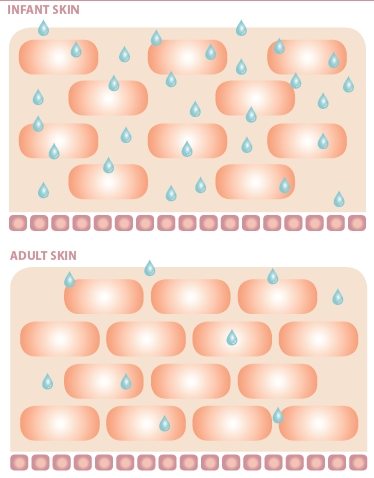
Dry, scaly skin is common in babies, but it can occur at any stage of development. Infant skin differs from adult skin in structure, function, and composition.8b,18a
During the late foetal period (20 weeks to birth), skin becomes functional and develops a protective barrier.18b
Although full-term infants are born with a competent skin barrier, their skin is still developing through the first year of life. Ideally, products used on infants should not interfere with skin surface pH or perturb the skin barrier.18b,c,d
INFANT SKIN HAS A HIGHER RATE OF WATER LOSS THAN ADULT SKIN AND IS AT A HIGHER RISK OF DEHYDRATION
MAINTAIN YOUR BABY’S SKIN BARRIER FUNCTION
Back to top
Maintaining skin barrier function is essential for survival and critical to preventing organ dehydration.18g
Emollients have been used for centuries to protect the integrity of the outer skin layer (stratum corneum) and to maintain skin barrier function. Appropriately formulated emollients can preserve, protect, and enhance the infant skin barrier by supplying the stratum corneum with water and lipids and by helping to inhibit water loss. Emollient products containing a physiological balance of cholesterol, ceramides and fatty acids are optimal for barrier repair. On the other hand, inappropriately formulated emollients can harm and dehydrate infants’ delicate skin.6a,9c,15a,b,c,17a
Daily use of emollients that are appropriately formulated for use after birth may produce measurable benefits later in life.18h,i
SEE THE DIFFERENCE FEEL THE DIFFERENCE
Back to top
FIRSTLY, SBR® REPAIR CREAM AND SBR® LIPOCREAM ARE DEVELOPED BY DERMATOLOGISTS9C
SBR® REPAIR CREAM DEEP PENETRATION AND A LONGER-LASTING EFFECT
Back to top
- SBR® Repair cream contains nanoparticles which allow it to penetrate deeper into the skin and be more effective.1j
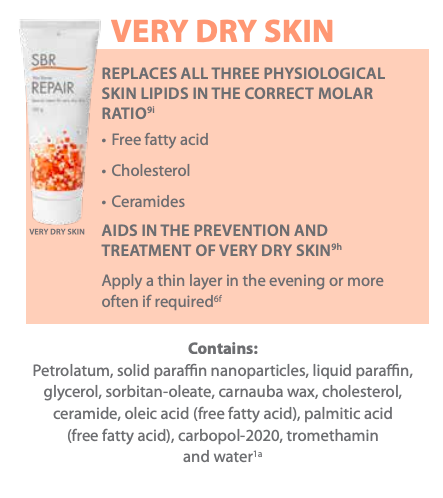
- It also contains the three most common lipids identical to your skin’s lipids. These lipids inhibit water from escaping from the skin and include fats, oils and waxes (cholesterol, ceramides and fatty acids).9c,11a
- SBR® Repair cream reaches the spaces between the cells in the stratum corneum to replace the lost natural lipids in the optimal proportions to restore and accelerate the skin’s protective barrier repair. 6a,d,9c
- Furthermore, it is an easy-to-apply cream base; it does not contain any colouring, perfume or preservatives (all potential irritants), minimising the risk of allergic reactions.6d,e,9g
- Finally, SBR® Repair cream also repairs the skin barrier after laser resurfacing and has been shown to significantly reduce oozing during the first two days after the CO2 laser treatment.20a
SBR® REPAIR CREAM WORKS EFFECTIVELY
Back to top
- Ideal for chronic dry conditions and doesn’t irritate the skin.6e,9f,12d
- Can be used as prophylactic skin care to minimise damage to the skin barrier.6a,12d
- Increasing the time between flare-ups of atopic eczema (can be used at any stage for eczema flare-ups).12d,15a
- Maintain the skin’s pH at the right level for faster barrier repair and maintenance.1f,21a
- Last for up to twenty-four hours6a,g
Patented nanoparticle technology prolongs its efficacy and produces a cosmetically acceptable matt finish. 1j
SBR® LIPOCREAM SELF-DEFENSE FOR YOUR SKIN
Back to top
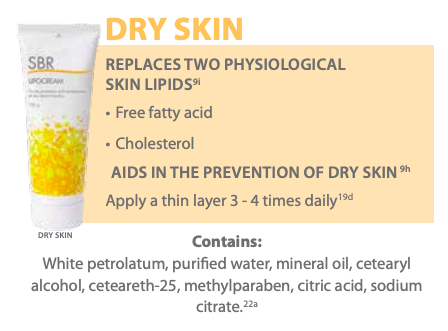
SBR® Lipocream replaces two of the skin’s physiological skin lipids (free fatty acids and cholesterol). It is less fatty than SBR® Repair cream and contains 38 % lipids compared to the 70 % of lipids contained in SBR® Repair cream. SBR® Lipocream can be applied 3 to 4 times daily on the affected skin areas if necessary.9i,j,19d
GLOSSARY
Back to top
- Atopic dermatitis: A chronic inflammatory skin disease of unknown origin that usually starts in early infancy but also affects many adults.
- Ceramide: A natural lipid molecule found in the outer layer of the skin.
- Eczema: Patches of skin become rough and inflamed with blisters which cause itching and bleeding.
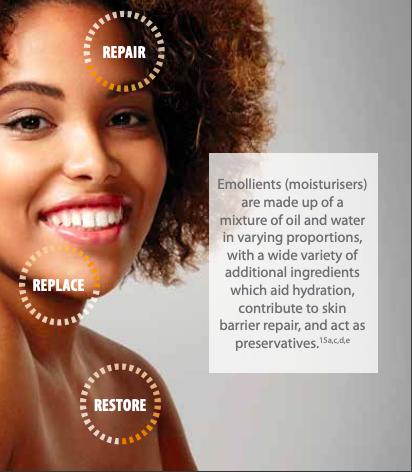
- Emollients: A moisturiser that helps keep the skin moist and supple by reducing water loss from the epidermis, the outer layer of skin. They provide a protective film. They are made up of a mixture of oil and water in varying proportions, with a wide variety of additional ingredients which aid hydration.
- Hydrophobic: A substance that has little or no affinity for water.
- Nanoparticles: A microscopic particle with dimensions less than 100 nanometers.
- Psoriasis: A skin condition that causes a thick, patchy, red rash with silvery, white scales.
- Sebum: An oily or waxy substance secreted by the skin’s glands to lubricate and waterproof the skin
- Stratum corneum: The outermost layer of the skin.
- Trans Epidermal Water Loss (TEWL): Water loss through the skin due to damage to the skin barrier.