
KNOW EARLY
Back to topIf you have type 2 diabetes mellitus (T2DM), your body does not make enough insulin or cannot use insulin as well as it should.1
Insulin is a hormone made by your body to help it use sugar from the carbohydrates you eat (e.g. bread, pasta).2 Without insulin, or with too little of it, your blood sugar levels (blood glucose) keep rising, which causes a range of symptoms and may cause long-term health problems.1,3
COMMON SYMPTOMS OF T2DM ARE:
Back to top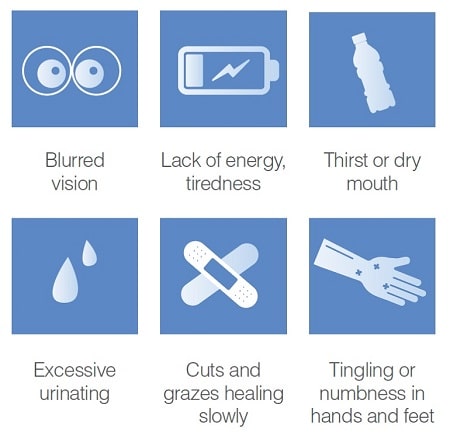
If you are worried about T2DM, speak to your doctor.2 Knowing you have T2DM is an important first step in taking control of the condition, rather than letting the condition take control of you.2,4
ACT PROMPTLY
Back to topUp to 15 % of South Africans over the age of 25 have T2DM.5 Knowing if you are one of them can help you take control of the condition.2
Getting a prompt diagnosis and starting treatment and self-care for T2DM can help you feel better and prevent future problems.1,3,4,6
If left undiagnosed, untreated or poorly controlled, T2DM can cause a number of complications which are unpleasant and can be life-threatening.6 These include heart problems, stroke and blindness.6
To reduce your risk of complications, it is important to bring your blood sugar levels under control.3,6

CHOOSE HEALTHY
Back to topWith T2DM, your health is in your hands:7 following your prescribed treatment and choosing a healthy lifestyle and diet are essential in managing your condition.1 For some, changes to diet and lifestyle can even ‘reverse’ T2DM.8
To bring your blood sugar levels under control:9
- Get physically active (30 minutes/day)
- Stop smoking
- Lose weight if overweight
- Take medications as prescribed
- Look after your feet!
- Attend all medical appointments
- Eat a diabetes-friendly diet
Eat a healthy diet9
- If overweight, reduce the calories in your food
- Replace saturated fats (e.g. dairy products) with unsaturated fats (e.g. avocado, nuts, olive and vegetable oils)
- Eat dietary fibre (e.g. fruit, vegetables, whole grains)
- Avoid excessive alcohol
- Avoid added sugar, particularly sugary drinks
GET SUPPORT
Back to topWhile self-care is important, remember you are not alone in caring for yourself. It is important to enlist the help of others.9
Support from your healthcare provider:
They will explain and advise on lifestyle and diet changes, what medicines to take, and when and how to take them.9 They may also refer you to a diabetes specialist for further support.10
Various medications may be prescribed.9 Taking the right medicines now may reduce your risk of future complications.11
A recent study shows that taking a combination of two medicines (combination therapy) at the start of treatment can both improve blood sugar control and delay the need to take insulin.11 Whatever your recommended treatment, the key is to follow it as prescribed.3
Support from your loved ones:
Support from family and friends as you live with T2DM may benefit your health.12 Together with your loved ones, take time to learn as much as possible about the condition, how to manage it, and how they can best support you.13
Take Control
Back to topBeing diagnosed with T2DM can feel frightening and overwhelming,13 but you are not alone.5 Diagnosis and early treatment can help you feel good today – and in the future.3
Take control of your blood sugars and your health today!
Find out more:
Back to top- The Diabetes SA website provides information about the condition and offers phone and chat support
- The Sweet Life is a community for people living with diabetes which also offers support to those living alongside people with diabetes
- Type 2 diabetes. International Diabetes Federation. Last update October 16, 2020. Accessed October 26, 2022. https://www.idf.org/aboutdiabetes/type-2-diabetes.html.
- Diabetes. nhs.uk. Last reviewed July 11, 2019. Accessed October 26, 2022. https://www.nhs.uk/conditions/diabetes/.
- 4 steps to manage your diabetes for life. National Institute of Diabetes and Digestive and Kidney Diseases. Last reviewed January 2016. Accessed October
26, 2022. - Herman WH, Ye W, Griffin SJ, et al. Early detection and treatment of type 2 diabetes reduce cardiovascular morbidity and mortality: a simulation of the results of the Anglo-Danish-Dutch Study of Intensive Treatment in People with Screen-Detected Diabetes in Primary Care (ADDITION-Europe). Diabetes Care. 2015;38(8):1449-1455. https://www.niddk.nih.gov/health-information/diabetes/overview/managing-diabetes/4-steps.
- Pheiffer C, Pillay-van Wyk V, Joubert JD, et al. The prevalence of type 2 diabetes in South Africa: a systematic review protocol. BMJ Open. 2018;8(7):e021029.
- Complications. International Diabetes Federation. Last update 26 October 2022. Accessed October 26, 2022. https://www.idf.org/aboutdiabetes/ complications.html.
- Self care for people with type 2 diabetes. NHS Lanarkshire. Review date March 2020. Accessed 26 October 2022. https://www.nhslanarkshire.scot.nhs.uk/download/diabetes-patient-information-leaflets/?ind=1553773748061&filename=Self-Care-for peoplewith-Type-2 Diabetes.pdf&wpdmdl=5302&refresh=5fe3cafbba3b91608764155
- Reversing type 2 diabetes. Diabetes UK. Published n.d. Accessed October 26, 2022. https://www.diabetes.org.uk/diabetes-the-basics/type-2-reverse.
- IDF clinical practice recommendations for managing type 2 diabetes in primary care. International Diabetes Federation. Published 2017. Accessed October 26, 2022. https://www.idf.org/e-library/guidelines/128-idf-clinicalpractice-
recommendations-for-managing-type-2-diabetes-in-primary-care.html. - Kok A, Hariram A, Webb D, et al. Patterns of diabetes management in South Africa: baseline and 24-month data from the South African cohort of the DISCOVER study. Journal of Endocrinology, Metabolism and Diabetes in South Africa. 2021;26(2):60-65.
- Matthews D, Del Prato S, Mohan V, et al. Insights from VERIFY: early combination therapy provides better glycaemic durability than a stepwise approach in newly diagnosed type 2 diabetes. Diabetes Therapy. 2020;11(11):2465-2476. Novartis South Africa (Pty) Ltd.
- Rad GS, Bakht LA, Feizi A, et al. Importance of social support in diabetes care. Journal of Education and Health Promotion. 2013;2:62.
- Wexler DJ. Patient education: type 2 diabetes: treatment (beyond the basics). UpToDate. Accessed October 26, 2022.
Novartis South Africa (Pty) Ltd. Reg. No.:1946/020671//07. Magwa Crescent West, Waterfall City, Jukskei View, 2090. Tel. +27 11 347 6000.
ZA2211092657. Exp.: 14/05/2023.