WHERE ARE WE WITH HIV TREATMENT IN 2020?
Back to topWith approximately 7.5 million people (of all ages) in South Africa living with HIV at the end of 2019, there is still an enormous need to create awareness and improve access to effective medicines for all.2a,3a

HOW IS HIV TREATED?
Back to topThere is no cure for HIV, but treatment with HIV medicines, called antiretroviral therapy (ART), can slow or prevent HIV from advancing from one stage to the next. HIV medicines help people live longer, healthier lives.4a
People on antiretroviral therapy take a specific combination of HIV medicines every day, called an ART regimen.4b HIV medicines are grouped into different drug classes according to how they fight HIV.4b
GOALS OF HIV TREATMENT
Back to topIt is important to know that antiretroviral therapy cannot cure HIV but does help people with HIV live longer, healthier lives. HIV medicines also reduce the risk of HIV transmission (spread to others).4c
- One of the main goals of treatment is to reduce a person’s viral load to an undetectable level. People with HIV who maintain an undetectable level of virus in their blood have no risk of transmitting HIV to their HIV-negative partner through sex.4c
WHAT ARE THE BENEFITS OF HIV TREATMENT?
Back to topAll people living with HIV are eligible to be provided with lifelong treatment, regardless of age, clinical status or CD4 count, including children, adolescents and adults, and pregnant and breastfeeding women.1b,5a
Treatment can offer the following benefits to patients:4a,c,6a
- slow down the progression of HIV through the stages
- prevent HIV from advancing from one stage to the next
- help people with HIV live longer, healthier lives
- reduce the risk of transmission to HIV-negative people
Without treatment, HIV infection advances in stages, getting worse over time.4d
DECIDING ON TREATMENT FOR EACH PATIENT
Back to topThe World Health Organisation and National guidelines recommends ART for all people with HIV as soon as possible after diagnosis without any restrictions of CD4 counts.1a,6b
There are certain steps that must be taken to decide on appropriate therapy for each individual patient, these are:1c
- Determine the timeframe for starting treatment
- Decide on first- or second-line treatment
- Choose the drugs in the regimen
- Provide education to encourage adherence to medication
In some instances, treatment will not be started immediately after diagnosis. Special screening (testing) will be done to find out if a patient has tuberculosis (TB) or any other chronic condition or infection that may affect the type of medication that can be prescribed.1d
For example, if a patient is found to have TB at the time of testing for HIV, antiretroviral therapy will only be started after a minimum of 2 weeks after starting TB treatment when a person is stable on the TB treatment.1e For further information on HIV and co-infection with TB, read here: https://private.medinformer.co.za/health_subjects/hiv-8-tuberculosis-tb/
Starting daily antiretroviral therapy as soon as possible after diagnosis and staying on treatment are essential for keeping HIV under control, which benefits individual health and prevents HIV transmission to others.7a
DID YOU KNOW?
Back to topBecause of antiretrovirals, HIV infection has transformed from an almost uniformly fatal infection into a manageable chronic condition!7
DIFFERENT TYPES OF HIV MEDICINES
Back to top
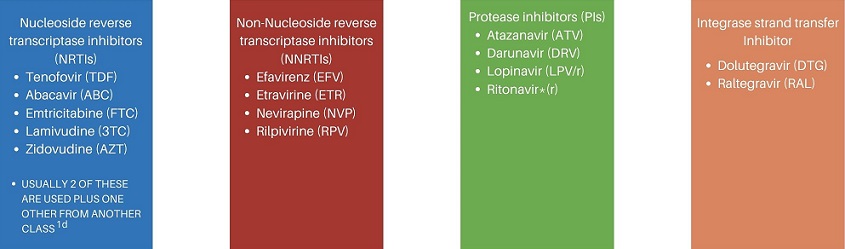
The following table lists the names of the medicines (active ingredients) and their unique identifying abbreviation.8 This information is quite complex and if you have any questions relating to specific medicines, please ask your healthcare professional
WHAT IS NEW IN HIV TREATMENT?
Back to topContinual research takes place to discover new ARV options with better tolerability and efficacy, offering patients improved quality of care.5b,7b Since 2019, a new regimen has been preferred.1g To improve the lives of people living with HIV a new regimen called ‘TLD’ is now preferred.9a,b A TLD regimen offers patients:9a,c
- 3 medicines in 1, with a new drug called Dolutegravir (DTG)
- one pill, taken once-a-day
- rapidly suppresses the HIV virus
- unlikely to have resistance
- less side effects
- smaller tablet – making it easier to take
TLD is recommended by the World Health Organisation for first-line treatment of HIV. It can also be used in second-line and third-line treatment of HIV.5b,9b
TLD is manufactured and supplied by several pharmaceutical companies and comes in different colours, shapes and sizes – all contain the same ingredients.9e
IS TLD RECOMMENDED FOR EVERYONE?
Back to topEach HIV regimen is chosen according each person’s individual needs.10a TLD can be taken by any person over the age of 10 and over 35kg in weight.1h Pregnant women and those planning for pregnancy have a choice and should discuss the benefits and potential risks of TLD with their healthcare provider to make an informed choice.9d
TEE is another alternative first-line ART regimen.1i,9d Speak to your healthcare professional about which may be best for you.
WHEN WOULD A PATIENT REQUIRE A SWITCH OF THERAPY FROM FIRST-LINE TO SECOND-LINE OPTIONS?
Back to topTogether with an increased viral load on repeated occasions, declining CD4 and/or increased opportunistic infections will confirm that the medication will need to be changed.1j
A ‘failure’ of medication is sometimes caused by suboptimal treatment adherence.1j Before switching, the reasons for medication ‘failure’ will be assessed. These include:1k

TARGETS AND MILESTONES OF THE NATIONAL HIV PROGRAMME
Back to top- having 90% of people living with HIV know their status
- 90% of those diagnosed initiated on HIV treatment, and
- 90% of those on treatment being virally suppressed.
To accelerate progress towards these targets, we have seen the introduction of a new antiretroviral medicine called Dolutegravir (DTG), which will offer patients:1
- improved efficacy
- a high barrier to resistance
- good tolerance
- improved health outcomes
There are many factors that are considered when your doctor chooses an HIV treatment regimen, including if there are other diseases or conditions that the person may have, whether they may be pregnant, possible side effects or interactions they may experience, as well as the suitability of the regimen to the patient.1,10 Can the patient swallow tablets? Are they able to follow the instructions? The best regimen for a person depends on their individual needs.10



HIV 2 – Treatment

HIV 2 – Treatment

HIV 2 – Treatment

HIV 2 – Treatment

HIV 2 – Treatment