

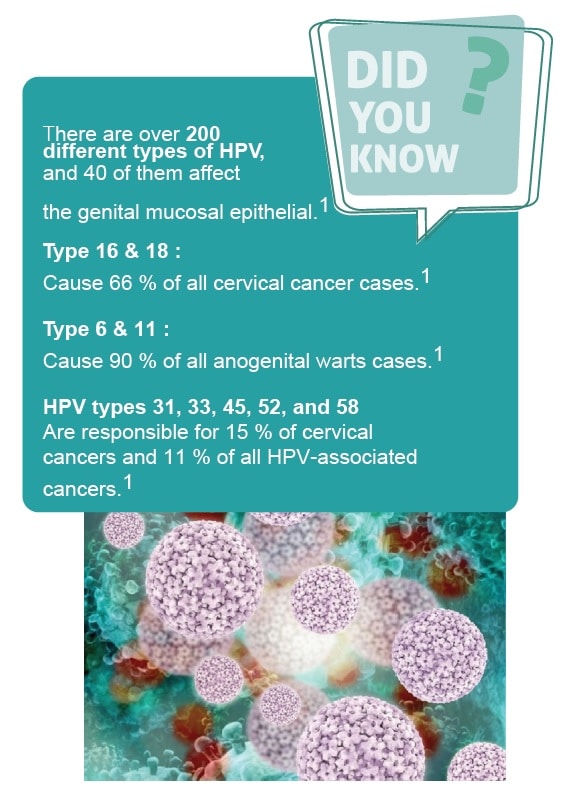
Human Papillomavirus (HPV) is a common, easy transmittable virus that for some can cause serious health issues now and in the future.2
ABOUT HPV
Back to topHuman Papillomavirus (HPV) is a common, easily transmittable virus that for some can cause serious health issues now and in the future.1,2
For most young individuals infected with HPV, the virus goes away on its own. If the virus does not go away it can develop into genital warts, precancerous lesions, or even HPV related cancers such as cervical, vulvar, vaginal, anal, and penile cancer, depending on the HPV type.1,2
HPV is resistant to heat and drying and can survive on inanimate objects such as clothing and laboratory equipment that have come in contact with infected patients, although the precise survival time is unknown.3
For physical inactivation, heating to 100 degrees and UV irradiation are needed. Hypochlorite and PAA (peroxyacetic acid)-based disinfectants with 45 minute contact time were the only ones with significant effect on the virus.4
HPV can survive undetected on skin or under your fingernails.5
DISEASES CAUSED BY HPV INFECTION
Back to topAsymptomatic Infections
HPV infection usually has no symptoms.1 In about 90% of people, HPV infections will be cleared within 2 years.1 Sometimes if HPV infections are not cleared, several months to years may elapse before lesions develop and can be clinically detected.2
Genital Warts
- One of the most common types of sexually transmitted infections.6
- Genital warts affect the moist tissues of the genital area.6
- Small, flesh-coloured bumps or have a cauliflower-like appearance. In many cases, the warts are too small to be visible.6
- Not life threatening. But they can be life altering and embarrassing. Even after treatment, genital warts can come back. The recurrence rate can be as high as 25 %. 7
Recurrent Respiratory Papillomatosis (RRP)8
- When types 6 and 11 cause wart type lesions in the respiratory tract this is known as Recurrent Respiratory Papillomatosis (RRP)
Cancers caused by HPV
Back to top
PREVENTION
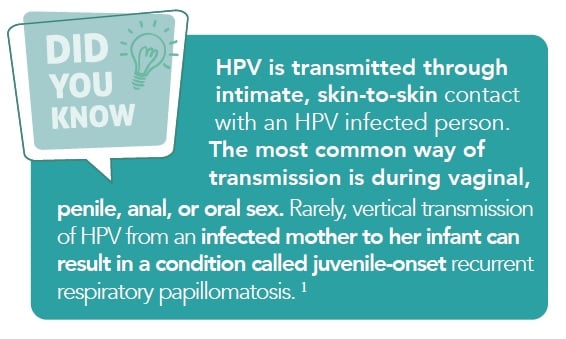
Back to topHPV transmission can be reduced, but not eliminated, with consistent and correct use of physical barriers e.g., condoms.1
VACCINATION:
Back to topHPV vaccination provides strong protection against new HPV infections.9
Vaccination is prevention and does not cure an infection once you have it. The HPV vaccine is not used to treat HPV infections or diseases caused by HPV.9
HPV vaccine is generally well tolerated. Safety has been well established from prelicensure trials and post licensure monitoring and evaluation.1
The HPV vaccine is given in multiple doses depending on recipients age.10
Please note: This is an education information brochure only and should not be used for diagnosis. For more information on Human Papillomavirus, consult your healthcare professional.


Human Papillomavirus (HPV)

Human Papillomavirus (HPV)
Human Papillomavirus (HPV)
Human Papillomavirus (HPV)
Human Papillomavirus (HPV)